
Metering for Part L2 Compliance in Non-Domestic Buildings
A modern metering system provides the ability not only to comply with the latest regulatory requirements, such as Part L2 and ESOS but also to unlock significant energy savings.
How can metering improve your energy efficiency?
Metering helps you better understand how a building is performing and identify areas to make energy savings, as well as understand how and where energy is being consumed. Simple energy savings can be achieved through behavioural changes, such as minimizing appliance standby usage.
Beyond these changes in energy usage, metering can be a significant step towards compliance with regulations for building design and construction. These regulations, such as Part L, now play a key role in the UK’s move towards Net Zero and contain amendments relating to the conservation of fuel and power.
What does Part L of the UK Building Regulations cover?
Part L encompasses the current 2021 document, which includes amendments made in 2023. It is split into two specific parts depending on the type of building:
- Part L1 – For domestic buildings
- Part L2 – For non-domestic buildings
To better understand compliance with Part L, the Chartered Institute of Building Services Engineers (CIBSE) has published guidance in their document CIBSE TM39:2009 , which provides information on complying with Part L using metering.
This guide covers the benefits of submetering, an overview of metering methodology, and an introduction to understanding metering readings.
What is new in Part L2 for non-domestic buildings?
The installation of submetering for energy measurement is now required in new buildings and when existing installations are extended where the floor area is greater than 1000m².
This metering can be installed to measure a number of uses, including heating, lighting, and HVAC, monitoring at least 90% of the building’s energy consumption over a year. The energy usage can be broken down by fuel type. Typically, energy usage is associated with electricity, but submetering can also monitor other fuel types, such as gas. Some electrical meters utilize pulse inputs to integrate outputs from existing devices into the data used to produce measurements.
The collected data needs to be usable for forecasting and to provide an indication of how well the building is performing. This can be achieved by utilizing energy management software; simple systems such as the Electrex Energy Brain software can output basic reports from the data polled from the meters. This software and its reports can also provide help with compliance with other regulations, such as ESOS, or even be used for ISO50001 certification.
Submetering enables data measurement at individual measurement points, allowing different parts of the building and even different processes to be monitored, providing a finer level of detail regarding energy usage.
Energy in modern buildings is increasingly being not only consumed but also produced, giving rise to the term “Prosumer Installation.” By using submetering, a building’s energy generation can also be monitored and integrated into reports and forecasts.
How do I decide on the correct type of energy submeter?
Energy submetering comes in varying types depending on the application. For example, if the metering is for fiscal building purposes or the metering of generated energy, the meter needs to be MID approved.
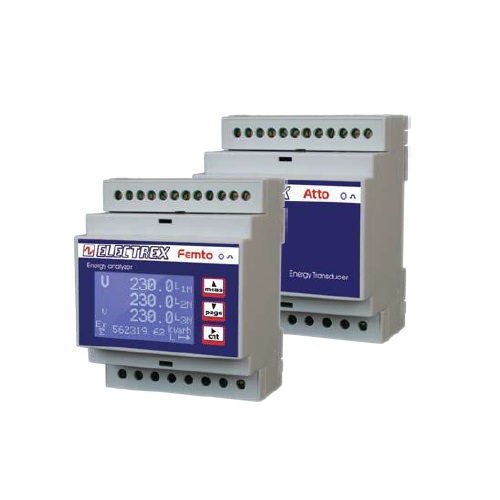
Image: Electrex Femto Submeters – DESNZ ETL Approved
Energy analyzers, such as the Electrex Femto, not only meter your energy consumption but also have the facility to measure additional data, such as harmonics, making them a simple option when basic power quality measurements are also needed. Fully featured power quality submeters are also available and introduce the measurements needed to fully understand the quality of the supply, as well as the energy usage and quality.
The minimum measurements needed for your submetering system are:
Table 1: Essential Energy Submeter Measurements
| Measurement | Purpose |
|---|---|
| kVAhr, kWhr, kVARh | Monitor billing costs |
| kVA, kW, KVAR, PF | Monitor system loading |
| THD, Harmonic, Voltage Events | Assess power quality |
Specific guidance on submetering criteria has been defined by DESNZ and can be found on their Energy Technology List website. The ETL is also a good source of information showing which submeters have been assessed by DESNZ and comply with their criteria. Submeters on the list are independently assessed and are in the top 25% of products available on the market. All of the Electrex range of submeters have been approved and feature on the Energy Technology List.
Where do I install the metering?
Metering can be installed at various locations depending on the type of energy and power data needed and the level of detail required for energy consumption and usage.
When considering locations, it is best to start at the point of the incoming supply. Here, a power quality meter can be installed, monitoring the overall energy consumption of the building, the quality of the supply, and any current harmonics potentially affecting voltage quality back on to the network.
As we move further down the supply, consider using energy analyzers for individual switchboards and larger process machines. Finally, for more detail, monitor individual loads or circuits, such as those for lighting.
How do I understand the metering data from all of my measurement points?
Some submeters have built-in displays, which, although useful for quick checks on energy data, do not provide the complete picture of how a building or process uses energy over time.
The interrogation of submetering can be done in a number of ways. Modern metering can have built-in web managers allowing individual meters to be accessed over the Ethernet. Data is presented through the user’s browser and contains limited information, including live measurements and a limited history profile of energy usage.
For more meaningful diagnosis of energy data, energy management software can be installed. This software can be either cloud-based or installed locally on the building’s own server.
Table 2: Data Interrogation Methods
| Method | Description |
|---|---|
| Built-in Web Managers | Access individual meters via Ethernet for live measurements and limited historical data. |
| Energy Management Software | Cloud-based or locally installed software that automatically polls meters and generates custom reports. |
The software automatically polls the meters to receive the energy and power data and allows for automation of reports depending on who and what needs to be seen. For example, finance managers may only need to confirm the kWhr measurement to verify the billing cost, whereas production managers may need to monitor the loading and power quality to ensure processes are running efficiently and without issue.
How do I start with an energy management system?
Systems can start with a very simple and basic configuration. Energy management meters installed at targeted locations can be simply connected to existing Ethernet infrastructure with a standalone software package installed to poll and produce basic reports of the data.
By using the simple approach described in ISO50001 of Plan, Check, Measure, Act, a company can start along the road to compliance with regulatory requirements or help customers integrate these systems into new buildings. Software, such as the Electrex Energy Brain, can grow with the requirements of the building by unlocking additional modules and features as and when the customer starts to need them instead of committing to an overly complex system from day one. Additional submeters can be connected and configured as the metering requirements change and measurement points increase.
Learn more about our products and services by visiting our Power Quality Expert product catalogue, Sonel product catalogue , Electrex product catalogue or Elspec product catalogue or you can contact us to discuss your measurement requirements further.
You can also follow Power Quality Expert on LinkedIn for regular news on products, events and technical updates.