
Voltage Sags (Dips) and Swells in power quality measurements
Voltage sags (also known as voltage dips) and swells (or surges) are the most common types of power quality disturbances. Every electrical system or equipment is designed to work at a specific voltage rating and changes in voltage below or above the defined low and high limit might damage electronic and industrial equipment, cause outages and other power quality issues.
What are voltage sags (dips)?
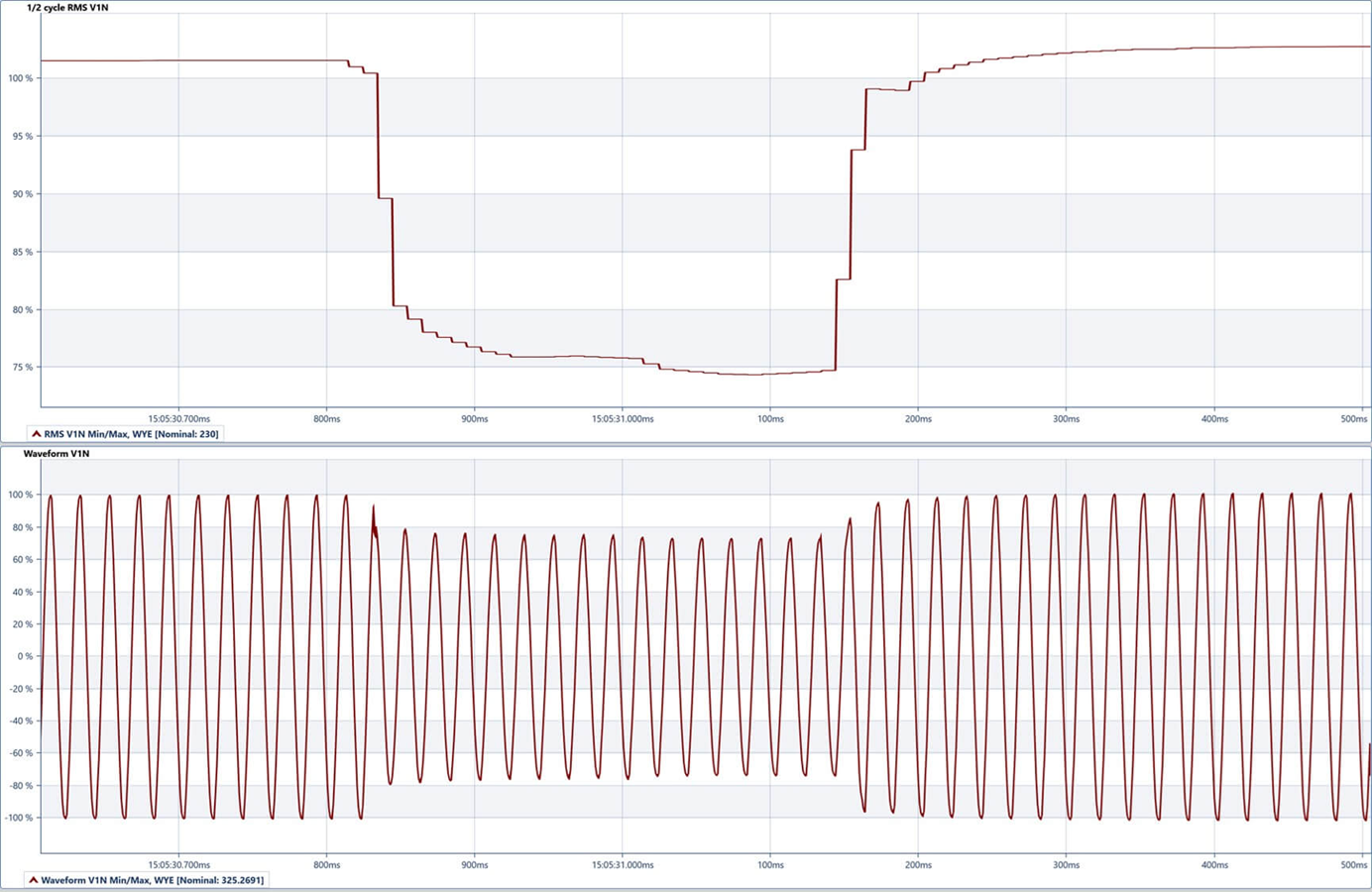
A voltage sag (dip) is a brief reduction in RMS voltage of 10% or more below the recommended range for a period of 1/2 cycle to 1min as defined in the IEC 61000-4-30 standard. The cause of it is a sudden large change of load through the source impedance such as in a motor startup or a short circuit event. Voltage sags (dips) are a common power quality event that can occur several times per year at a typical industrial sites PCC (Point of Common Coupling) and even more at the equipment terminals. In more recent years, it is now required that electrical equipment has the ability to “ride through” brief voltage sag events with the requirement depending on the sag characteristics and the application.
Voltage RMS 1/2 cycle and waveform charts during a voltage sag (dip)
What are voltage swells?
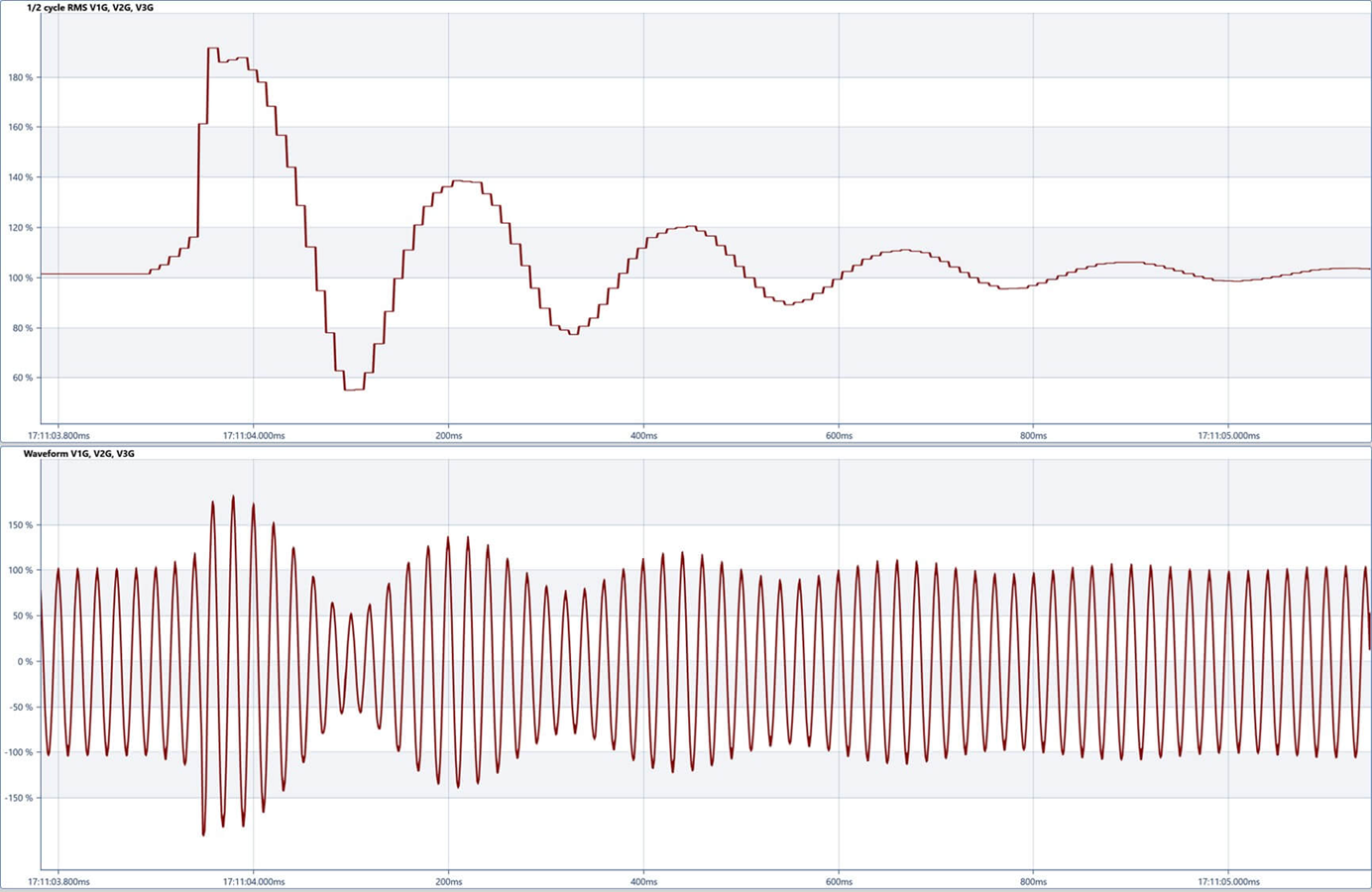
Voltage swells are the opposite of voltage sags (dips) and they are defined as a momentary increase in RMS voltage of 10% or more above equipment recommended voltage range for a period of 1/2 cycle to 1 min, as defined in the IEC 61000-4-30 standard.
Voltage swells are less common than voltage sags (dips) and they are usually related to system fault conditions. Swells can occurs as a result of a single line to ground fault, which will briefly raise the voltage level of the un-faulted phases as shown in the example below. This is more likely to happen in an ungrounded or floating ground delta systems. Swells can also occur when a large load is turned OFF.
Voltage RMS 1/2 cycle and waveform charts during a voltage swell
Overcoming power disturbances
In order to solve these events and reduce their frequency, a monitoring and analyzing process is required. The recent IEEE 1668 standard Recommended Practice for Voltage Sag and Short Interruption Ride-Through Testing for End-Use Electrical Equipment Rated Less than 1000V details how to deal with this types of voltave event. This allows software packages, such as Elspec Sapphire, to translate the data to an easy view and simple graphs. Using this kind of software, combined with advanced power quality meters and power quality analyzers for measurements, enables you to gather a full record of voltage dips, swells and other power disturbances.
A power quality analyzer with a continuous waveform recording will capture almost any event in your network without the need to set triggers or thresholds manually to capture events. This advanced analyzer will enable you easy deployment and the ability to connect the event to a specific state to figure the cause of the problem. Defining magnitudes and durations of sags that should not result in equipment failure, for example, and the ability to tell the severity of the sag history on the facility will improve, by default, the stability and reliability of your system and equipment.
Learn more about our products and services by visiting our Power Quality Expert product catalogue, Sonel product catalogue , Electrex product catalogue or Elspec product catalogue or you can contact us to discuss your measurement requirements further.
You can also follow Power Quality Expert on LinkedIn for regular news on products, events and technical updates.